
On-Grid vs Off-Grid Solar System: Which One is Better for Homes?
Table of Contents
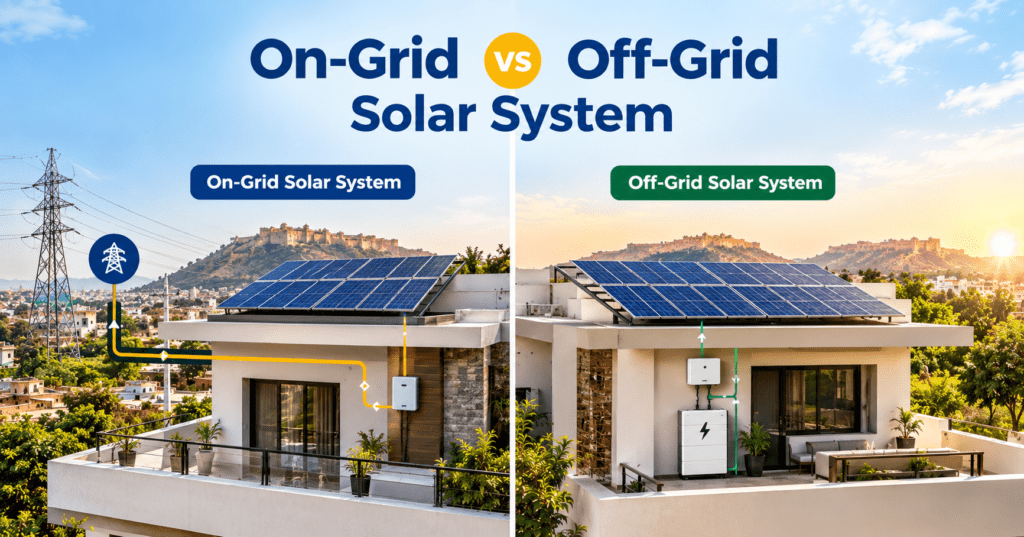
Choosing solar for your home is a long-term investment. But before installing solar panels, one important question needs to be answered: Should you choose an on-grid or off-grid solar system? Both systems can help homeowners use solar energy, but they work differently and are designed for different requirements. An on-grid solar system works alongside the electricity grid, while an off-grid solar system operates independently with battery storage. For homeowners looking for a Solar System for Home in Jaipur, the right choice depends on electricity consumption, power-cut frequency, budget, rooftop space and whether battery backup is important.
Let’s compare both systems so you can make a more informed decision.
What Is an On-Grid Solar System?
An on-grid solar system is connected to the local electricity grid. Solar panels generate electricity during the day, and the home uses that solar power first. Depending on the system and applicable regulations, excess electricity may be exported to the grid through a net-metering arrangement. One of the biggest advantages of an on-grid system is that it generally does not require a battery for normal operation.
Benefits of an On-Grid Solar System
- Helps reduce electricity bills
- Usually has a lower upfront cost than an equivalent off-grid setup
- Does not require battery replacement as part of the basic system
- Makes good use of available rooftop space
- Suitable for homes with reliable grid connectivity
- Can be a practical option for reducing long-term electricity expenses
However, there is one important limitation. A standard grid-connected solar system generally shuts down during a grid outage for safety reasons. Therefore, it should not be considered a backup power system unless it has an appropriate backup configuration.
What Is an Off-Grid Solar System?
An off-grid solar system operates independently of the electricity grid. It generally combines solar panels with batteries and other required equipment to store electricity for use when sunlight is unavailable. During the day, solar panels generate electricity. Some of the power can be used immediately, while surplus energy can charge the batteries. The stored energy can then be used at night or during periods when solar generation is low.
An Off Grid Solar System for Home can be particularly useful in locations where grid electricity is unavailable or unreliable.
Benefits of an Off-Grid Solar System
- Can operate independently of the electricity grid
- Provides battery-based power backup
- Useful in areas with frequent or prolonged power cuts
- Can support essential appliances when the grid is unavailable
- Reduces dependence on conventional grid electricity
The main consideration is the battery. Batteries increase the initial investment and eventually require replacement depending on their technology, usage and operating conditions.
On-Grid vs Off-Grid Solar System: Key Differences
| Feature | On-Grid Solar System | Off-Grid Solar System |
|---|---|---|
| Grid connection | Required | Not required |
| Battery | Usually not required | Required |
| Power during grid outage | Standard system generally stops | Can provide backup |
| Initial investment | Generally lower | Generally higher |
| Battery maintenance | Not applicable to basic setup | Required |
| Electricity bill reduction | Strong potential | Depends on system design and usage |
| Best suited for | Homes with reliable grid supply | Areas needing energy independence |
| Main advantage | Lower-cost solar generation | Backup and grid independence |
On-Grid vs Off-Grid Solar System: Which One Is Better for Homes?
There is no single answer for every homeowner.
If your home already has a reliable electricity connection and your main goal is to reduce monthly electricity bills, an on-grid system can be a practical choice.
On the other hand, if your area experiences frequent power cuts and maintaining electricity during those outages is a priority, an off-grid system may be more suitable because of its battery storage.
Your decision should therefore be based on your actual electricity requirements rather than simply choosing the system with the lowest initial price.
Which Solar System Is Better for Homes in Jaipur?
For homeowners searching for an On Grid Solar System in Jaipur, grid-connected solar can be attractive because it allows them to use rooftop solar while remaining connected to the existing electricity network.
Jaipur receives substantial sunlight during much of the year, making rooftop solar a practical consideration for residential properties. However, actual solar generation depends on factors such as system capacity, roof orientation, shading, weather conditions and equipment quality.
An on-grid system can make sense for a Jaipur household where the primary objective is reducing electricity expenses and the existing grid supply is reasonably reliable.
An Off Grid Solar System in Jaipur may be worth considering when backup power and independence from the grid are more important. It can be particularly relevant for properties where power interruptions are a significant concern or where reliable grid connectivity is not available.
Cost, Maintenance and Electricity Bill Savings
The total cost of a solar installation depends on its size, equipment, installation requirements, mounting structure and other project-specific factors.
Generally, an on-grid system can have a lower initial cost because a basic setup does not require battery storage. An off-grid system requires batteries, which can significantly affect the overall investment.
Maintenance is another factor homeowners should consider. Solar panels need periodic cleaning and inspection, while electrical components should be checked as recommended by the installer or manufacturer.
Read More: Learn more about solar system maintenance and the important checks that can help maintain system performance.
Electricity bill savings also vary from one home to another. Your results can depend on electricity consumption, system capacity, solar generation, electricity tariff, shading and applicable policies.
If your goal is to understand how solar can potentially reduce your electricity expenses, read our guide: ₹0 Electricity Bill Kaise Possible Hai.
Remember that ₹0 electricity bills should not be treated as a guaranteed result. Actual bills depend on individual consumption, solar generation and applicable electricity regulations.
Factors to Consider Before Choosing a Solar System
Before selecting an On Grid Solar System for Home or an Off Grid Solar System for Home, consider these factors:
1. Your Monthly Electricity Consumption
Check your recent electricity bills to understand how much electricity your household actually uses. This helps determine an appropriate solar system size.
2. Power-Cut Frequency
If your area has reliable grid electricity, an on-grid system may meet your primary requirements. If frequent outages are a major concern, battery-backed off-grid solutions deserve consideration.
3. Your Budget
Do not compare only the solar panel price. Consider installation, inverter, mounting structure, battery requirements, maintenance and future replacement costs.
4. Available Rooftop Space
The available shadow-free roof area can affect the number of panels that can be installed and therefore the possible system capacity.
5. Backup Requirements
Ask yourself whether you need electricity during grid outages. If backup is essential, an off-grid or suitably designed backup-enabled solution may be more appropriate.
6. Future Electricity Needs
If you expect electricity consumption to increase because of additional appliances, electric vehicles or other household requirements, discuss future capacity needs before installation.
FAQs About On-Grid and Off-Grid Solar Systems
Is an on-grid or off-grid solar system better for a home?
It depends on your requirements. On-grid systems are generally suitable for homes focused on reducing electricity bills, while off-grid systems are better suited to situations where backup and grid independence are priorities.
Is an on-grid solar system suitable for homes in Jaipur?
Yes, it can be a practical option for homes in Jaipur with reliable grid connectivity and suitable rooftop space. The right system size depends on electricity consumption and site conditions.
Does an off-grid solar system work during power cuts?
Yes. Since an off-grid system operates independently and uses battery storage, it can provide electricity during grid outages when properly designed and maintained.
Does an on-grid solar system need batteries?
A standard on-grid solar system does not normally require batteries. It uses the electricity grid alongside the solar installation.
Which system costs more: on-grid or off-grid?
An off-grid system generally costs more initially because it requires battery storage and additional equipment for independent operation.
Can solar completely eliminate my electricity bill?
Not necessarily. Solar can significantly reduce electricity expenses, but actual savings depend on system size, consumption, solar generation, tariffs and applicable policies.
Final Thoughts
Choosing between an on-grid and off-grid solar system is less about finding one universally “better” option and more about finding the system that matches your home. For many homeowners with reliable grid electricity, an on-grid solar system can be a practical way to generate solar power and reduce electricity expenses without the additional cost of battery storage.
For homes where power backup and energy independence are essential, an off-grid solar system can offer greater independence through battery storage. Before making a decision, evaluate your electricity consumption, rooftop space, budget, power-cut situation and future energy requirements. A properly sized and professionally installed system can help you get better value from your investment in solar energy.