
Net Metering Explained: Everything You Need to Know (2026)
Table of Contents
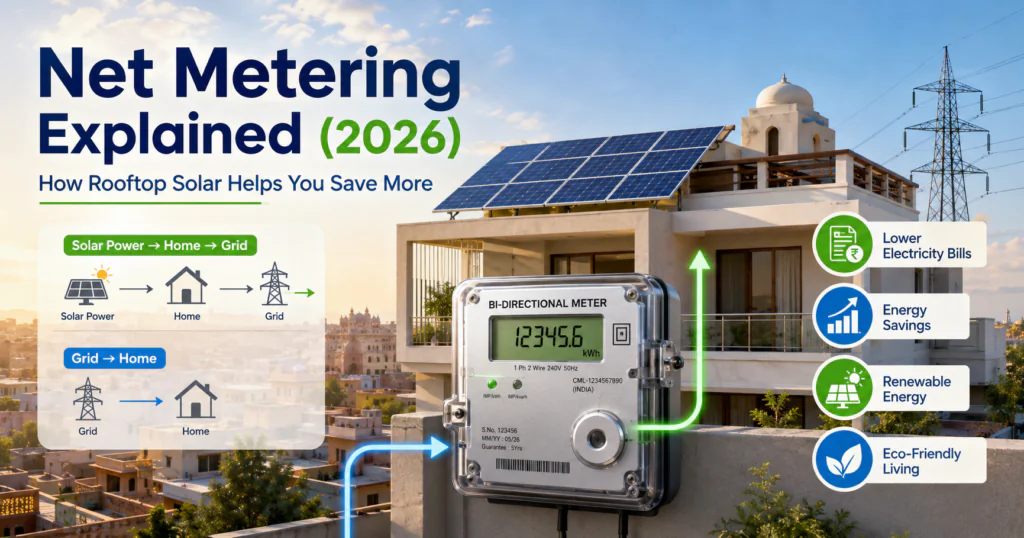
Electricity prices continue to rise every year, making rooftop solar one of the smartest investments for homes and businesses. However, installing solar panels is only one part of reducing your electricity bills. To maximize your savings, you also need to understand Net Metering.
If you’ve ever wondered what happens to the extra electricity your solar panels generate during the day, the answer is simple it doesn’t go to waste. Through Solar Net Metering, that excess power is sent back to the electricity grid, and you receive credits that help reduce your future electricity bills.
Whether you’re planning a Residential Solar System, managing a Commercial Solar System, or searching for a trusted Solar Company in Jaipur, understanding net metering is essential before investing in solar energy. In this complete guide, we’ll explain everything you need to know about Net Metering in India, including how it works, who can apply, how billing is calculated, and the latest updates for 2026. We’ll also share practical examples from Jaipur and Rajasthan to help you understand how net metering can significantly increase your solar savings.
What is Net Metering?
Net Metering is a government-approved billing system that allows owners of rooftop solar systems to export surplus electricity to the power grid and receive credits against their electricity consumption. During sunny hours, your solar panels often generate more electricity than your home or business requires. Instead of wasting this extra energy, it is automatically supplied to the local electricity grid through a Bi-Directional Meter.
Later, when your solar panels are not producing enough electricity such as during the night or on cloudy days you can draw electricity from the grid. At the end of the billing cycle, your electricity provider calculates the difference between the electricity imported and exported. You pay only for the net electricity consumed . This mechanism makes rooftop solar systems much more economical by ensuring that every unit of electricity your panels produce contributes to lowering your electricity bill.
Why is Net Metering Important?
Without net metering, any excess electricity generated by your solar panels would be wasted unless you installed an expensive battery storage system. Net metering allows you to use the existing electricity grid as a virtual battery. Instead of storing excess electricity in physical batteries, you send it to the grid and receive energy credits that you can use later. This offers several benefits:
- Maximum utilization of solar power
- Lower electricity bills
- Faster return on investment
- Better overall system efficiency
- Reduced dependence on conventional electricity
For homeowners and businesses in Jaipur, where sunlight is available for most of the year, net metering significantly increases the value of investing in rooftop solar.
How Does Net Metering Work?
The working process of Solar Net Metering is simple and fully automatic. Your rooftop solar system first supplies electricity to your home or business. If your electricity consumption is lower than the energy generated, the remaining electricity flows into the utility grid through a Bi-Directional Meter.
Whenever your solar panels produce less electricity than required, your property automatically receives power from the grid. At the end of the month, the electricity distribution company compares:
- Units imported from the grid
- Units exported to the grid
The difference between these two values determines your final electricity bill.
Step-by-Step Working Process
Step 1: Solar Panels Generate Electricity
During daylight hours, sunlight falls on your rooftop solar panels and generates DC electricity. An inverter converts this into AC electricity that can be used by your appliances.
Step 2: Your Home Uses Solar Power First
Your property always consumes solar electricity before taking electricity from the grid. This helps reduce your dependence on conventional electricity throughout the day.
Step 3: Extra Electricity is Exported
If your solar system generates more electricity than you consume, the extra units automatically flow into the electricity grid. The exported electricity is recorded by the Bi-Directional Meter.
Step 4: Electricity is Imported When Needed
At night or during cloudy weather, your solar panels produce little or no electricity.
Your home or office automatically imports electricity from the grid. The imported units are also recorded separately by the same meter.
Step 5: Final Billing
At the end of the billing cycle, the electricity company subtracts exported units from imported units. You pay only for the remaining units.
Example of How Net Metering Works
Imagine a family in Jaipur installs a 5 kW Rooftop Solar System. During one month:
| Particular | Units (kWh) |
|---|---|
| Solar Electricity Generated | 650 |
| Electricity Used Instantly | 350 |
| Electricity Exported to Grid | 300 |
| Electricity Imported from Grid | 180 |
Billing Calculation
Net Units = Imported Units − Exported Units
180 − 300 = –120 Units
In this case, the household exported more electricity than it imported. Depending on the applicable DISCOM policy, these surplus units are carried forward as credits or adjusted according to prevailing net metering regulations.
This is one of the biggest reasons homeowners prefer installing rooftop solar systems with net metering.
Understanding the Bi-Directional Meter
A Bi-Directional Meter is one of the most important components of a net metering system. Unlike a traditional electricity meter that only measures electricity consumed from the grid, a bi-directional meter records electricity flowing in both directions. It accurately tracks:
- Electricity imported from the grid
- Electricity exported to the grid
This enables the electricity distribution company to calculate your net electricity consumption accurately. Without this special meter, net metering cannot function.
What Makes a Bi-Directional Meter Different?
| Normal Electricity Meter | Bi-Directional Meter |
|---|---|
| Records imported electricity only | Records both imported and exported electricity |
| Suitable for regular consumers | Required for rooftop solar systems |
| No export tracking | Automatically tracks exported solar energy |
| Used in conventional connections | Used with approved net metering connections |
Why is the Bi-Directional Meter Important?
The bi-directional meter ensures transparency and accurate billing by recording every unit of electricity exchanged with the grid. It also helps:
- Prevent billing errors
- Monitor solar performance
- Ensure fair credit for exported electricity
- Comply with DISCOM net metering regulations
If you’re planning Solar Panel Installation in Jaipur, your solar installer will guide you through the meter installation process after your application is approved by the local DISCOM.
Benefits of Net Metering
Net metering is one of the biggest reasons rooftop solar systems offer excellent long-term value. It helps homeowners and businesses make the most of every unit of electricity generated by their solar panels.
1. Lower Electricity Bills
The biggest advantage is reduced monthly electricity costs. Since exported units are adjusted against imported units, your payable bill can decrease significantly.
2. Better Return on Investment
By earning credits for surplus electricity, your solar system delivers higher savings, helping you recover your investment faster.
3. Maximum Use of Solar Energy
Instead of letting excess electricity go unused, net metering ensures every unit generated contributes to financial savings.
4. No Need for Large Battery Storage
The electricity grid acts like a virtual storage system, reducing the need for costly battery banks in many grid-connected installations.
5. Environment-Friendly
Every unit of solar electricity used or exported reduces dependence on fossil-fuel-based power generation, helping lower carbon emissions.
6. Higher Property Value
Homes and commercial buildings with rooftop solar systems and net metering are often seen as more energy-efficient and can be more attractive to buyers or tenants.
Residential Example: Jaipur Home
A family living in Vaishali Nagar, Jaipur installs a 3 kW Residential Solar System. During the day:
- Most household appliances run on solar power.
- Excess electricity generated while the family is away is exported to the grid.
- At night, electricity is imported as required.
- The exported units are adjusted against imported units, reducing the monthly electricity bill.
With Jaipur’s abundant sunshine, this setup can lead to substantial savings over the system’s lifetime, especially when paired with approved net metering.
Commercial Example: Jaipur Business
A retail showroom in Mansarovar installs a 25 kW Commercial Solar System to reduce operating costs. The business consumes a significant amount of electricity during office hours, while weekends and holidays often result in excess solar generation. Instead of letting that energy go unused, the surplus is exported to the grid through a bi-directional meter and credited under the applicable net metering policy. For commercial establishments with consistent daytime operations, net metering helps improve energy efficiency, lower electricity expenses, and shorten the payback period on the solar investment.
Who is Eligible for Net Metering in India?
Most homeowners, commercial establishments, educational institutions, industries, and government buildings with an approved Rooftop Solar System can apply for Net Metering. However, the exact eligibility criteria may vary depending on your state’s electricity distribution company (DISCOM) and the latest regulatory guidelines.
Before applying, make sure your property meets the following basic requirements:
- A legal electricity connection in your name.
- A rooftop suitable for installing solar panels.
- A grid-connected solar PV system.
- Solar panels and inverter that comply with DISCOM standards.
- Installation completed by an approved solar installer.
- Compliance with the latest state electricity regulations.
If you’re planning a Solar Panel Installation in Jaipur, it’s always a good idea to check the latest Rajasthan DISCOM guidelines or consult an experienced installer like Solarwala to ensure your project meets all technical requirements.
Net Metering Application Process
The process of applying for Solar Net Metering has become much simpler in recent years. While the exact procedure may differ slightly between states, the overall steps remain similar across India.
Step 1: Assess Your Electricity Consumption
Start by reviewing your electricity bills to understand your monthly energy usage. This helps determine the ideal capacity of your rooftop solar system.
A properly sized system ensures maximum savings and better utilization of net metering.
Step 2: Choose a Reliable Solar Installer
Select an experienced Solar Company in Jaipur that provides:
- Site survey
- System design
- Quality solar panels
- Government-approved components
- Documentation support
- Net metering assistance
- After-sales service
Working with a trusted installer minimizes delays during approvals and installation.
Step 3: Submit the Net Metering Application
The application is submitted to your local electricity distribution company along with the required documents. Typical documents include:
- Identity proof
- Address proof
- Latest electricity bill
- Property ownership documents (if applicable)
- Solar system specifications
- Single-line electrical diagram
- Installer details
Step 4: Technical Inspection
The DISCOM reviews the application and may inspect the installation to verify that it complies with technical and safety standards.
Step 5: Install the Bi-Directional Meter
Once the application is approved, the existing electricity meter is replaced (or upgraded) with a Bi-Directional Meter, enabling the recording of both imported and exported electricity.
Step 6: Grid Synchronization
After successful inspection and meter installation, your rooftop solar system is connected to the electricity grid, and net metering becomes operational.
From this point onward, every surplus unit generated by your solar panels can be exported to the grid.
Net Metering vs Gross Metering
Many people confuse Net Metering with Gross Metering, but the two systems work differently.
| Feature | Net Metering | Gross Metering |
|---|---|---|
| Electricity generated | Used first by the consumer | Entire electricity exported to the grid |
| Electricity bill | Based on net consumption | Consumer pays separately for imported electricity |
| Exported electricity | Adjusted against imported units | Purchased by DISCOM at applicable tariff |
| Savings | Usually higher for self-consumption | Depends on feed-in tariff |
| Best suited for | Homes, offices, shops | Large commercial or utility-scale projects |
Which One is Better?
For most homeowners and small businesses, Net Metering is generally the preferred option because it allows you to use your own solar power first and receive credits for surplus electricity exported to the grid. However, the applicable metering mechanism depends on the regulations issued by your state electricity regulator and DISCOM.
Latest Net Metering Rules in India (2026)
Solar policies continue to evolve, so it’s important to stay updated with the latest regulations. Some key points applicable in 2026 include:
- Net metering is available for eligible grid-connected rooftop solar consumers, subject to state regulations.
- Installation must comply with the technical standards prescribed by the respective DISCOM.
- A bi-directional meter is mandatory.
- Only approved solar equipment should be used.
- Exported electricity is adjusted according to the applicable billing regulations and tariff orders.
- Consumers should always verify the latest guidelines issued by their State Electricity Regulatory Commission (SERC) and local DISCOM before installation.
Since policies may change over time, always refer to the official government portal and your electricity distribution company for the most up-to-date information. you can also learn more about rooftop solar and subsidy schemes through the official PM Surya Ghar: Muft Bijli Yojana
Net Metering in Jaipur & Rajasthan
Jaipur enjoys abundant sunshine for most of the year, making it one of the best locations in Rajasthan for rooftop solar adoption. Whether you own:
- An independent house
- A villa
- A commercial office
- A retail showroom
- A school
- A warehouse
- A factory
Net metering can help you maximize the value of your solar investment by reducing electricity bills and improving your system’s return on investment.
Before installation, always confirm the latest net metering guidelines with your local DISCOM, as procedures and eligibility requirements may be updated from time to time.
Expert Tips Before Installing a Rooftop Solar System
- Choose high-quality solar panels and an efficient inverter.
- Install the correct system size based on your electricity usage.
- Work with an experienced and trusted solar installer.
- Keep your solar panels clean for better performance.
- Understand your state’s net metering regulations before installation.
- Use only approved equipment that complies with DISCOM standards.
- Monitor your system’s performance regularly through the inverter or monitoring app.
- Schedule periodic maintenance to maximize long-term efficiency.
Why Choose Solarwala for Rooftop Solar Installation?
Choosing the right installer is just as important as choosing the right solar panels. At Solarwala, we provide complete end-to-end rooftop solar solutions, including:
- Free site assessment
- Customized solar system design
- Premium-quality solar panels
- Professional installation
- Assistance with net metering documentation
- Support for government subsidy applications (where applicable)
- Reliable after-sales service
- Residential and commercial solar solutions across Jaipur and Rajasthan
Our experienced team helps you make the transition to clean energy with confidence, ensuring your system is designed for maximum performance and long-term savings.
Conclusion
Net metering is one of the most valuable features of a grid-connected rooftop solar system. It ensures that every extra unit of electricity generated by your solar panels contributes to lowering your electricity costs instead of going to waste. Whether you’re a homeowner looking to reduce monthly electricity bills or a business aiming to control operating expenses, Net Metering makes solar energy a smarter and more rewarding investment.
If you’re planning a Solar Panel Installation in Jaipur or anywhere in Rajasthan, choosing the right solar partner is essential. From system design and installation to net metering support and after-sales service, Solarwala is here to guide you through every step of your solar journey.
Ready to switch to solar? Contact Solarwala today for a free consultation and discover how a rooftop solar system with net metering can help you save more every month.